
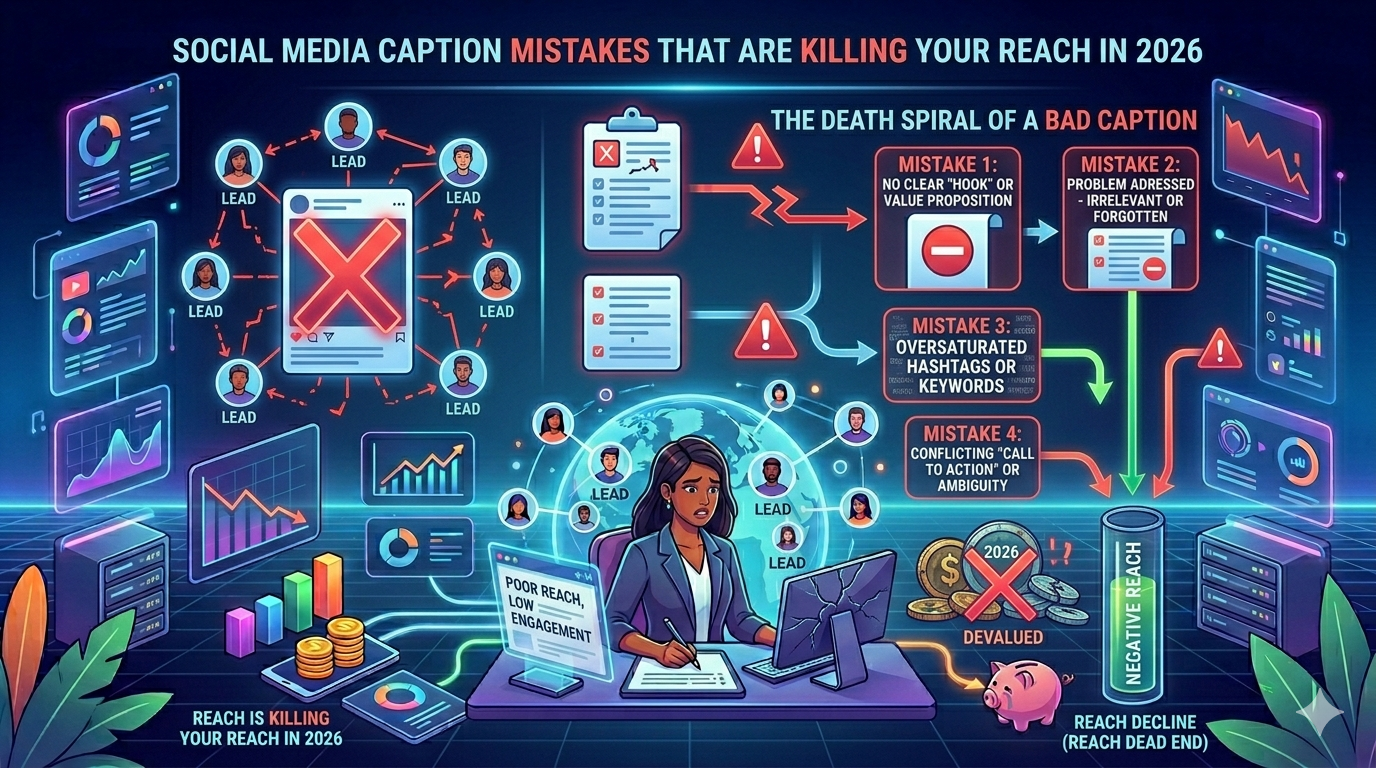
The Caption Mistakes That Are Silently Destroying Your Reach
Most creators spend significant time improving their visuals, their filming, their editing — and almost no time improving their captions. Yet in 2026, captions are one of the primary factors determining whether the algorithm pushes your content to new audiences or suppresses it entirely.
These are the ten most common caption mistakes we see across Instagram, TikTok, and LinkedIn in 2026 — and exactly how to fix each one.
Mistake 1: Starting With a Weak or Generic Opening Line
What it looks like: “Happy Monday!” / “Sharing some thoughts today…” / “Here’s a quick tip for you!” / “I’ve been thinking about this lately…”
Why it kills reach: Your first line is the only thing most people see before the “more” button. A weak opening gives them no reason to tap — and platforms interpret low tap-through rate as a signal that your content is not engaging enough to show to more people.
The fix: Write your hook last. After writing the full caption, craft a first line that creates a specific curiosity gap, makes a bold claim, or directly addresses your audience’s most pressing problem. “The one caption change that increased my saves by 340% 👇” beats “Some caption tips to share with you today!” every time.
Mistake 2: Using the Same Hashtag Set on Every Post
What it looks like: The same 15–20 hashtags copy-pasted onto every single post, indefinitely.
Why it kills reach: Instagram’s spam detection algorithm in 2026 flags accounts that use identical hashtag clusters repeatedly. The account is deprioritised in hashtag feeds — meaning your content becomes invisible to exactly the discovery tool you are trying to leverage.
The fix: Rotate your hashtags. Keep your core 3–4 niche tags consistent, but change at least 50% of your hashtag set on each post. CaptionMakerAI generates a unique hashtag mix every time you generate a caption, making automatic rotation easy.
Mistake 3: Writing For Yourself Instead of Your Audience
What it looks like: Captions that describe what is happening in the image (“Had such an amazing time at the event last night!”) or how you feel (“So grateful for everything this week”) without connecting to what value this has for the reader.
Why it kills reach: Captions that do not offer value to the reader generate low engagement — no saves, minimal comments, minimal shares. Platforms interpret this as low-quality content and reduce distribution.
The fix: Before writing every caption, ask “why would my specific audience care about this?” Then write the caption from that angle. Your amazing night at the event becomes “3 things I learned about [niche topic] at last night’s [event] that changed how I think about [problem your audience has].”
Mistake 4: A Weak or Missing Call to Action
What it looks like: “Hope you find this helpful!” / “Let me know what you think” / no CTA at all
Why it kills reach: Without a specific, compelling CTA, engagement rates drop. Platforms reward content that drives action — and “let me know what you think” is not specific enough to overcome the mental effort of leaving a comment.
The fix: End every caption with one specific CTA. Not “what do you think?” but “Which of these three mistakes are you most guilty of? Drop the number below 👇” The more specific the question, the lower the effort required to answer, and the higher your comment rate.
Mistake 5: Putting Links in LinkedIn Post Bodies
What it looks like: “I wrote a full article on this — check it out here: [link]” in the middle of a LinkedIn post.
Why it kills reach: LinkedIn’s algorithm suppresses posts with external links in the body by 50–70%. LinkedIn wants users to stay on the platform — any content that sends them elsewhere is penalised.
The fix: Always put your link in the first comment and reference it in your post: “Full guide in the first comment 👇” Your reach increases immediately.
Mistake 6: Caption Length Mismatched to Format
What it looks like: Writing a 400-word essay as a TikTok caption, or a single sentence as an Instagram carousel caption.
Why it kills reach: Each platform’s algorithm has learned what “normal” looks like for high-performing content. Content that deviates significantly from platform norms — including caption length — can be deprioritised.
The fix: Match your caption length to the platform and format. TikTok: 80–150 characters visible. Instagram Reels: 100–200 characters. Instagram feed posts: 150–400 words. Carousels: 200–400 words. LinkedIn: 150–250 words. CaptionMakerAI generates the right length automatically based on your platform selection.
Mistake 7: Irrelevant Hashtags Used for Reach
What it looks like: A fitness post using #love #instagood #photooftheday because they have millions of posts.
Why it kills reach: When your fitness content appears on #love hashtag feeds, the fashion and romance audience that frequents that hashtag will not engage with it — and low engagement on a hashtag page signals to Instagram that your content is a poor match for the audience that uses that hashtag. This can suppress your reach on your legitimate hashtags too.
The fix: Use only hashtags where your specific content fits the audience that uses that hashtag. Relevance always beats volume in 2026.
Fix All Seven Mistakes Automatically
Every caption generated by CaptionMakerAI is built to avoid all seven of these mistakes — platform-appropriate length, unique hashtag mixes, strong hooks, specific CTAs, and niche-relevant hashtag selection. Generate your next caption free at captionmakerai.com/.
FAQ: Caption Mistakes 2026
What is the most damaging caption mistake for Instagram reach?
In 2026, using identical hashtag sets on every post is the single most damaging caption mistake for Instagram reach. It directly triggers Instagram’s spam detection and can result in persistent reach suppression across all hashtag feeds — not just the repeated ones.
Does caption length affect reach on Instagram?
Length itself does not directly affect reach — but the content within that length does. However, there is a correlation: posts with longer, more substantial captions tend to have higher save rates (because they are more reference-worthy), and saves are the most powerful engagement signal for algorithmic distribution.